

|
|
 Meerkat |
Meerkat(Mammal) |
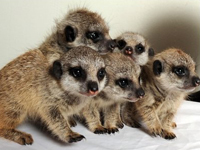 Meerkat Baby |
Meerkat HabitsThe meerkat is found exclusively on the semiarid plains of southern Africa. It avoids woodland and dense vegetation, preferring to live among the scrub. At night, the meerkat retires to a network of burrows witch it digs with its powerful forelegs. The burrows may be as deep as 10 feet. Sometimes the burrows are shared with other animals such as the ground squirrel and yellow mongoose. In rocky ground, the meerkat will make its den in the crevices between the rocks.
The meerkat is the most sociable of all the mongooses, living in close-knit colonies numbering as many as 2 dozen. Each meerkat has special duties that benefit the group as a whole. As meerkats emerge from the burrows, selected individuals will stand guard to keep watch for predators. They keep watch often in the branches of a tree, and bark out a warning at the first sign of danger. When meerkats face the threats of a rival group of meerkats or a predator, they begin digging up the ground frantically in order to create clouds of dust to distract their aggressor. Also, with their hair bristling, a group of meerkats may advance in a pack toward the enemy in a series of mock attacks designed to scare off the intruder. During such confrontations, the meerkat make themselves as large and fearsome as possible by stretching their legs, arching their bodies, and holding their tails stiffly erect. Once this is done, the entire group continually leaps into the air and growls aggressively. If the intruder persists, the bolder meerkats will bite. When forced on the defensive, the meerkat throws itself on its back with teeth bared and claws out-stretched to ward off its attacker. |
Meerkat CommunicationMeerkats constantly communicate with one another in three different ways: scent, sound, and body language. They have over 20 different sounds that have been recorded which have different meanings. These calls can be broken down into six different groups: lost calls, alarm calls, leading the group calls, pup feeding calls, guarding calls, and foraging calls. For example, while out looking for food, they are are constantly communicating in what sounds like a kind of growling. It helps them to keep track of one another's location since they forage up to 15 feet apart. When the young are learning how to forage, they are very loud and can be heard up to a hundred yards away. If they become separated from the adults, the volume of their cries increases so that an adult will come to get them. They have numerous sounds that are used when grooming and playing.
When on guard duty, there is an entirely different assortment of sounds employed. These sounds are constant and communicate to everyone else what is happening during the watch. When everything is fine, the sentry emits mellow tones. When a predator is spotted at a distance, a beeping sound is given, almost like a yellow alert. If the predator gets closer, the sound differentiates depending on the type of predator. The martial eagle tends to get the most frantic alarm even from great distance. Meerkats allow some predators to get very close before they sound the red alert (up to 100 feet from the den).
Interestingly, their sound can be broken up into one, two, three, and even four syllable calls. |
Meerkat BreedingWhen meerkats breed, the female will initially refuse the male, until he seizes her by the neck. Mating soon follows. The young are born blind and hairless after a gestation period of 11 weeks. The usual number of the litter is four, and within several days, the young are weaned.
The mother then leaves the burrow to hunt; other adult meerkats protect her young. At 3 weeks, the young meerkats emerge from the burrow for the first time, closely watched by their guardian. The mother introduces her young to unfamiliar food by running around with it in her mouth, encouraging them to snatch it from her. At 2 months, young meerkats resemble the adults.
A meerkat baby sitter will guard younsters diligently for hours on end while the rest of the group is hunting. |
Meerkat Food & FeedingMeerkats feed mainly on insects, spiders, and snails, but their prey also includes rodents, ground-nesting birds and their eggs, lizards, and bulbs and roots of select plants. They will even tackle dangerous prey such as scorpions and snakes. Relying on its keen sense of smell, the meerkat is a successful forager. With its prey in sight, the meerkat strikes out with its paws before killing it with a bite. The meerkat tears into it before taking the remains back to the burrow to share with the others. |
Meerkat Key Facts |
| Size |
| Height: 20 in. from head to the tip of tail |
| Weight: 2 pounds |
| Breeding |
| Sexual maturity: 12 months |
| Mating: Throughout the year |
| Gestation: 75 days |
| Number of young: 4-5 |
| Lifestyle |
| Habit: Highly sociable. Colonies of up to 30, but averaging 24 |
| Diet: Very varied but largely insects, grubs, scorpions, and lizards |
| Lifespan: About 10 years |
DID YOU KNOW?
|
CAN'T FIND WHAT YOU'RE LOOKING FOR? CLICK HERE!!!