

|
|
 Black Spider Monkey |
Black Spider Monkey(Mammal) |
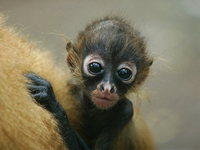 Black Spider Monkey Baby |
Black Spider Monkey HabitsThe black spider monkey has exceptionally long, slender limbs and an even longer tail. Where possible, the spider monkey will run on all fours along the tops of branches. But where there is a break in the intertwined canopy of the trees, it will swing or leap from one tree to another. On the rare occasion when the spider monkey sets foot on the ground, it may walk upright on two legs with its long tail held stiffly up against its back. The spider monkey lives in loose-knit, nomadic troops which vary in size according to the availability of food. There are usually no more than 18 monkeys per square mile of forest, but where food is plentiful, as many as 100 may live together.
Throughout much of its range, the black spider monkey is hunted by man for food. Being both noisy and quite large, the spider monkey is an easy target for darts or arrows. But because the young mature slowly and the rate of reproduction is low, it is easily over hunted and, in some areas, its populations have been wiped out completely. The spider monkey is also threatened by the destruction of rainforests. It is particularly vulnerable to habitat loss because it is unable to adapt to other habitats. |
Black Spider Monkey CommunicationSpider monkeys communicate their intentions and observations using postures and stances, such as postures of sexual receptivity and of attack. When a spider monkey sees a human approaching, it barks loudly similar to a dog. When a monkey is approached, it climbs to the end of the branch it is on and shakes it vigorously to scare away the possible threat. It shakes the branches with its feet, hands, or a combination while hanging from its tail. It may also scratch its limbs or body with various parts of its hands and feet. Seated monkeys may sway and make noise. Males and occasionally adult females growl menacingly at the approach of a human. If the pursuer continues to advance, the monkeys often break off live or dead tree limbs weighing up to 4 kg and drop them towards the intruder. They do not actually throw the branches, but twist to cause the branch to fall closer to the threat. The monkeys also defecate and urinate toward the intruder. |
Black Spider Monkey BreedingThe black spider monkey has no defined breeding season and gives birth at all times of year. Still, it is slow to mature and is unable to breed until it is five years old.
Once the female is sexually mature, she comes into estrus every 24-27 days. She may then mate with any of the adult males in her troop. The baby monkey, born 20 weeks after mating, clings tightly to its mother's abdomen for its first four months. When the young monkey is older, it rides on the mother's back, wrapping its tail around hers for security. Even when it becomes too big to be carried, the young rarely strays from its mother's side. Such prolong maternal care means that may young spider monkeys successfully reach maturity. But because a female will not breed while her young is in her care, the reproductive rate of the species is family low. Did You Know, relative to its size, the Spider monkey has a larger brain than other western hemisphere monkeys. The spider monkey will break off heavy branches and drop them from trees to scare off intruders. |
Black Spider Monkey Food & FeedingEach morning, The spider monkey troop breaks up into two or three smaller groups, which disperse to forage for food. The black spider monkey's large size means that it is not threatened by the eagles and hawks that prey on smaller primates. Consequently, it does not require the safety of a large group to be protected from predators. While feeding, the monkeys keep in contact with each other by their loud calls, which sound similar to the whinnying of a horse. The spider monkey feeds chiefly on fruit and nuts but also eats leaves, seeds, flower buds, birds' eggs, insects, and spiders. Fruit is an essential source of water. The spider monkey often suspends itself from a branch by a leg or its tail. This allows it to reach down to pluck fruit or flowers from the tip of a branch. Its long tail is do well adapted that is can pick up small objects such as nuts. |
Black Spider Monkey Key Facts |
| Size |
| Height: Head & Body Length: 15-22 inches. Tail 25-36 inches |
| Weight: Males: 21 pounds; Females: 19 pounds |
| Breeding |
| Sexual maturity: Males: 5 years. Females: 4 years |
| Mating: Year Round |
| Gestation: 225-232 days |
| Number of young: 1 every 2-3 years |
| Lifestyle |
| Habit: Social, day-active |
| Diet: Mainly nuts, fruit, leaves |
| Lifespan: Typically, up to 20years. Longest recorded, 33 years in captivity |
DID YOU KNOW?
|
CAN'T FIND WHAT YOU'RE LOOKING FOR? CLICK HERE!!!